Warehousing vs. Fulfilment
In the logistics industry, people often talk about warehousing and (e-)fulfilment. These two logistics services are often used interchangeably, but they are actually distinct from one another. We’d be happy to explain the difference to you.
What is warehousing?
First, let’s take a brief look at both concepts. Because What is warehousing What exactly is it? Warehousing is the storage of goods that will later be sold or distributed.
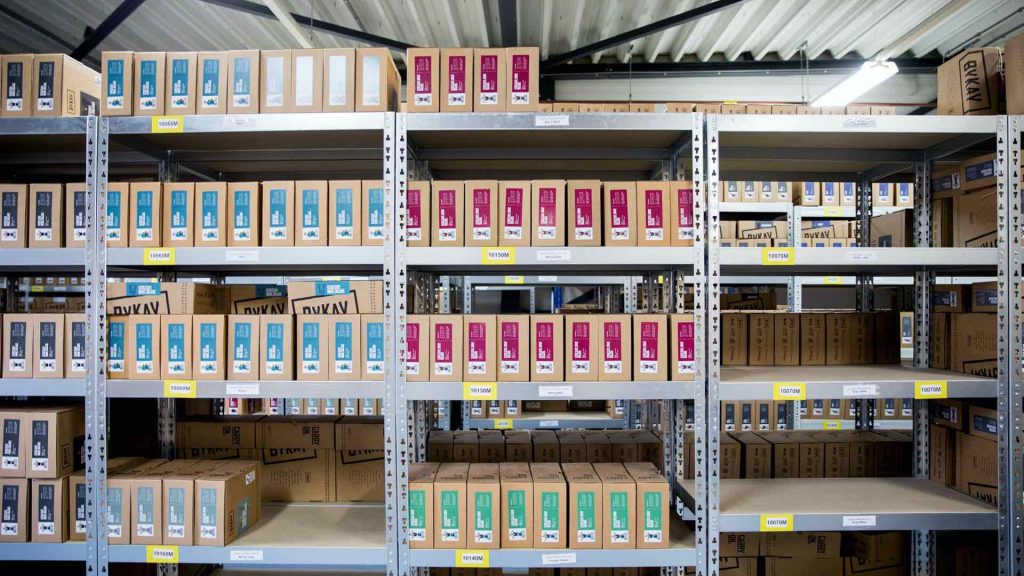
These goods (both food and non-food) are stored in a so-called warehouse, which is usually designed to accommodate products for short- or long-term storage. Since most companies lack the space to store inventory, they often rent storage space. The size of this space can range from an entire warehouse to one or more shelves, depending on the size of the inventory. Thanks to this external storage option, the customer does not need to manage inventory in-house. This saves on space and often on costs as well, since there is no need to invest in staff or a location.
Warehouse Management System
A warehouse is almost always equipped with an advanced warehouse management system (WMS). This so-called management system accurately tracks receiving, storage, and shipping. The system provides continuously updated inventory information on, among other things, quantity, number of incoming orders, packaging, transportation, and shipping, etc. In short: with a warehouse management system, both warehouse staff and customers always have insight into current inventory levels.
What is fulfilment?
You now know what warehousing entails. But what exactly is fulfilment? You can read about it here, but in short, fulfilment is the entire order processing process. By “entire,” we mean from A to Z—that is, from the moment an order is received until it is delivered to the customer.
Fulfilment and e-fulfilment
Fulfilment refers to the entire order processing process, but What is e-fulfilment Then what? E-fulfilment is simply the complete processing of orders received from online stores. So while fulfilment primarily involves orders from retailers, manufacturers, and/or wholesalers, e-fulfilment relates to online shopping. The rest of the process remains the same.
Difference between warehousing and fulfilment
Now we come to the crux of this story: what exactly is the difference between these two logistics services?
As mentioned, warehousing is the storage of goods. Fulfilment is more than that. The fulfilment process begins with putaway, the receipt of the goods. The goods are then stored in a warehouse. When an order comes in, order picking begins: products are gathered together, assembled if necessary, and then packed, prepared for shipment, and shipped.
| Warehousing | Fulfilment |
| Check-in (Reception & Registration) | Impact |
| Warehouse Storage | Warehouse Storage |
| Order Processing (order picking) | |
| Assembly and/or assembly | |
| Packaging, repackaging, or wrapping | |
| Shipping |
Conclusion: warehousing is therefore part of fulfilment!
Want to know more?
You now know the difference between warehousing and fulfilment. As a versatile logistics service provider, we also offer both of these services. So if you’re looking for a partner for reliable and cost-effective storage, inventory management, and order fulfilment, you’ve come to the right place. If you’re looking for a combination of these services, then 3PL services Maybe this is something for us.
Would you like to learn more about the options available for your business? Please feel free to contact us.