What is Fulfilment?

Fulfilment is a commonly used term in the logistics industry today. It is primarily used in the logistics for online stores and other businesses. But what is fulfilment So, what exactly is this, and what added value does it bring to your business?
The Definition of Fulfilment
Encyclo.nl provides the following definition:
“The processes focused on handling and processing the tasks and activities that arise from customer contact.”
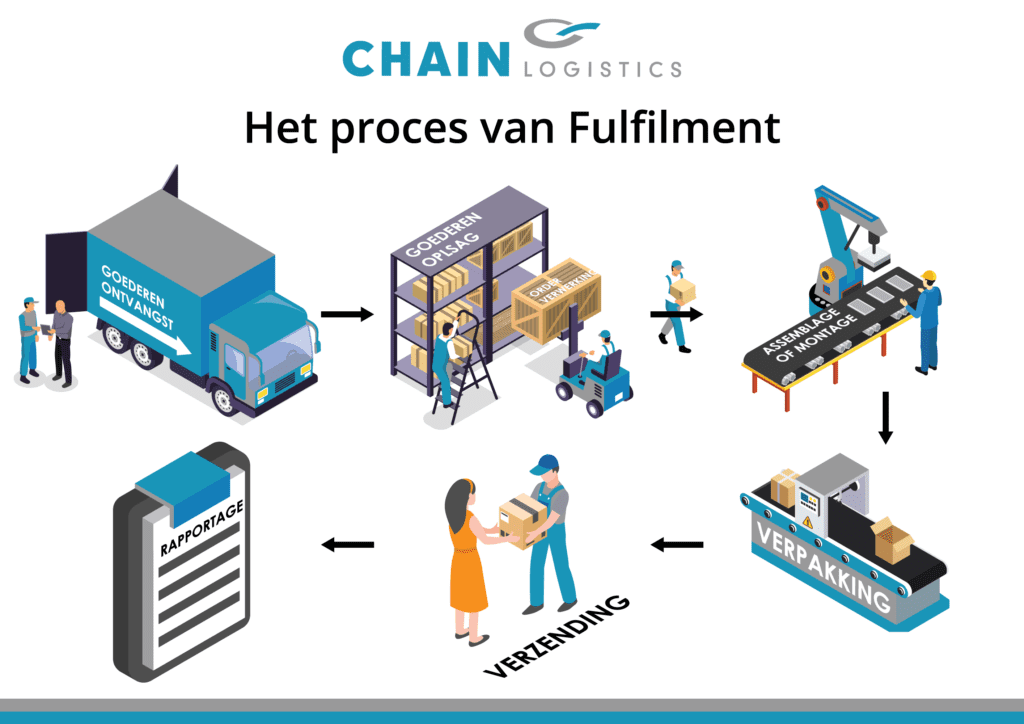
Fulfilment is, in fact, the entire order processing process: from the moment an order is received in the back-office system until it is delivered to the customer.
The fulfilment process
First, it is important that the customer's order system is integrated with the warehouse management system (WMS) of the warehouse (warehouse) where the ordered goods are stored. This is followed by a number of steps:
- Receipt of the goods. This refers to the goods arriving at the warehouse. These are received by warehouse staff, carefully counted, and inspected for damage. They are then entered into the WMS and stored in the correct location in the warehouse.
- The storage of goods. Goods are therefore stored in the warehouse. This is essentially always a custom solution. Different products require different storage conditions. For example, the storage of food products must meet different requirements than the storage of clothing. The stored products are recorded in the warehouse management system. This ensures that both the customer and the warehouse staff always have insight into inventory levels, which are always up to date.
- Order Processing. When an order comes in, the next step is order picking: gathering the correct products and preparing them for shipment. This must be done accurately because there is sometimes only a short amount of time between when an order is received and when it is shipped. On-time delivery is important!
- Assembly and/or installation. Sometimes a product still needs to be assembled or assembled. This is done before packaging and shipping.
- Pack up. If a product is complete, it can be wrapped or packaged. This, too, can be done in various ways, ranging from a simple shipping box to customized gift wrapping, and from personalized orders to sealed pallets.
- Send. Once the product is ready for shipment, it is handed over to the carrier. This may be a transportation company or a parcel service. They then ensure that the product reaches the correct recipient.
- Reporting. The entire fulfilment process is tracked in the warehouse management system. Accurate reports provide constant insight into current inventory, the number of products/packages shipped, the number of returns, the costs incurred per order, and so on.
Benefits of fulfilment
Fulfilment offers several advantages. For example, you no longer have to worry about inventory, and the processing of your sales is handled from start to finish.
In addition, fulfilment companies can often ship goods at more favorable rates. Because they typically take advantage of volume discounts, costs are reduced. Furthermore, goods are stored efficiently, which also lowers storage costs.
By outsourcing logistics processes, you’ll also often have more time to focus on what you do best: running your business.
Related Knowledge
Chain Logistics & fulfilment
The information above explains what fulfilment generally entails. Chain Logistics offers you a full range of professional fulfilment services. We are happy to handle your order processing from start to finish.
Are you looking for a reliable fulfilment partner? Please contact us.
Frequently Asked Questions About fulfilment
Business owners have a clear incentive to outsource the entire logistics process surrounding shipments: They want to focus on running their business and not have to worry about logistical hassles. The logistics provider they hire has all the resources needed to successfully transport the shipment from point A to point B by road, water, or rail.
As soon as you start bundling services, you’ll benefit from economies of scale. In addition to warehousing, consider bundling assembly and distribution with the same logistics provider. At that point, your company can qualify for improved pricing, which the logistics provider determines on a pro-rata basis.
For fulfilment, the lead time for products ranges from a few hours to a year. Products can also be shipped in phases based on incoming orders.
Transportation companies use a TMS, or Transportation Management System. Warehousing companies use a WMS, or Warehouse Management System. Chain Logistics uses both because fulfilment encompasses all processes, from packaging and storage to delivery. Customers with access to their own portal can use it to submit new orders or make changes.