I think, ‘Great, let’s keep it that way,” but my sons are already thinking ahead
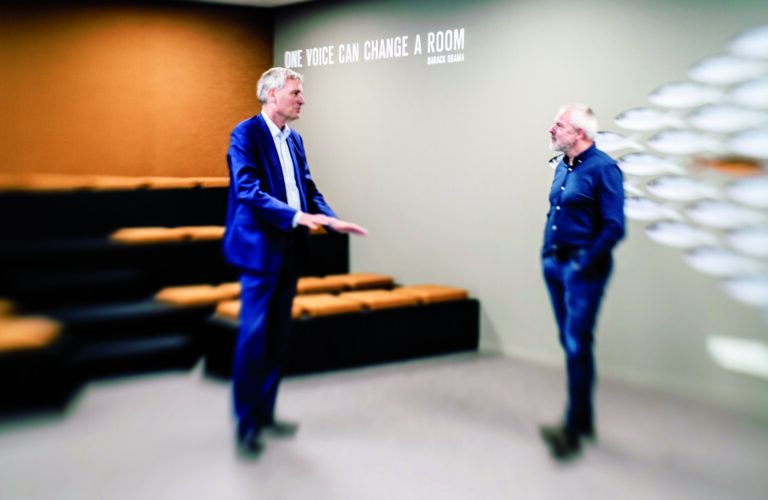
Entrepreneurs like to keep their businesses in the family. It’s a wonderful prospect: overcoming the transitory with the family, with eternity beckoning. Eric van Schagen and Rob Jansen—the heads of the IT company Simac in Veldhoven and Chain Logistics in Uden—share their experiences with one another. This company combines transportation, warehousing, and assembly with a generous dose of social commitment. Through various themes, the CEOs offer a glimpse into each other’s companies. On paper, the differences couldn’t be greater. Yet there’s a lot they recognize in each other.
‘Ownership is the most important thing. That they truly feel: ’I’m doing my part.’” – Eric van Schagen
In 1991, Eric van Schagen of Simac took over the reins from his father, who founded the company in 1971. Thirty years have passed since then. The same pattern will repeat itself in a year or two when Eric’s eldest daughter, son, and nephew—who are already on the executive board—take over the reins. That’s the plan. Simac employs 1,400 people across 15 locations.
Rob Jansen of Chain Logistics started his company 21 years ago. He had already had a successful career. Rob estimates he has about six more years left, after which he, too, will step down from the company, which now employs 85 FTEs. About 15% of the employees face barriers to the labor market and therefore need some extra guidance on the job. After the handover, he will make way for his two sons, who are currently part of management.
Spoiler alert: CEOs are far from worry-free when it comes to their ‘dream’ successors within the family. They know that succession is a human endeavor. It’s all about motivation, quality, and momentum. Guarantees of success? There aren’t any.
Eric is fascinated by Rob’s story—how he has managed to channel his interest in social entrepreneurship into Chain Logistics. “I always want to bring out the best in people,” says Rob. “Even back when I started a courier company, more or less out of dissatisfaction with the companies I’d worked for. Where business always came before people—I just couldn’t get on board with that. You hear and read about it a lot these days: engaging, inspiring, and retaining employees. It’s a no-brainer. You bring out the best in employees by making them feel like they own their work—by giving them the sense that they’re making a difference. That also applies to people who are distanced from the labor market, whom we’re happy to support here.”
‘Every company deserves to shine brighter. Someone at the helm with ambition, who wants to move forward.’ – Eric van Schagen
“We strive to be as profitable as possible on a structural basis so that we can grow,” says Rob. “Our goal is to make even better social choices. Our clients—for whom we make a difference—understand this, partly because they find our social cross-pollination innovative. To a certain extent, the human element is our most important yardstick. In the past, we gave everyone who showed interest in our company a chance. We’ve become stricter about that. The balance between social responsibility and profit is now in equilibrium. My sons want to continue on this path.”
Doers and Highly Educated Thinkers
“A logistics environment like Chain Logistics seems to me to be very well-suited to providing people with extra guidance and helping them thrive,” says Eric. “That’s right,” says Rob, “in our assembly hall, we perform mostly unskilled, often very meticulous work. Think of preparing packaging, applying labels, and handling products
putting things together. The work is often repetitive in nature. With a little guidance from dedicated team leaders, it goes perfectly. Of course, there’s no question of manual labor at Simac, Eric?” “People in our industry are often highly qualified thinkers,” says Eric. “Even for some of them, it’s difficult to find a place in the job market. They could really use an extra push. We offer that, for example, by outsourcing programming work to companies that are specifically set up to work with people on the autism spectrum. I think it’s better in our industry to keep those worlds—autistic and non-autistic—separate. If we didn’t do that, I foresee uncomfortable situations arising among employees. I want to avoid that. Our approach to social return through outsourcing works.”
Eric wonders what will become of Chain Logistics’s social aspirations after the transfer. “Inclusive entrepreneurship is ingrained in your company. That’s precisely why clients choose Chain Logistics. I think it’s important that your sons embrace their social responsibility.” “We try to operate in a way that’s structurally profit-
”to be as giving as possible, so that we can grow,“ says Rob. “With the goal of making even better social choices. Our clients—for whom we make a difference—understand this, in part because they find our social cross-pollination innovative. To a certain extent, the human element is our most important yardstick. In
”In the past, we gave everyone who showed an interest in our company a chance. We’ve become stricter about that. We’ve now struck a balance between social responsibility and profit. My sons want to continue along those lines."
Growth
From a bedroom in 1971 to 15 locations in the Netherlands, Belgium, Luxembourg, France, the Czech Republic, Germany, and the UK today: Simac is an excellent example of how knowledge, expertise, and quality have translated into growth over the years. More than two decades of Chain Logistics demonstrate that there are other paths to growth as well
Growth can also mean streamlining and consolidating by divesting locations, thereby focusing on quality. “Regardless of strategy, opportunities sometimes come your way,” says Rob. “In our case, those opportunities led, at one point, to four locations in four municipalities. Unfortunately, as a social enterprise, the municipalities provided us with only a trickle of suitable candidates, even though that is an important responsibility of municipalities. That wasn’t getting us anywhere. It brought us back to basics, with one solid location in Uden. Here we are now in a brand-new building, with plenty of opportunities to expand and focus on quality. That, too, is growth.”
‘For us, the focus is on the company and all employees—including those who aren’t family. I feel a strong sense of responsibility for that. When I took over my father’s company, I hadn’t expected this.’—Erik van Schagen
“You can aspire to strategic growth, but achieving it is another story,” says Eric. “Back when I wanted to talk big and aim for 20 percent growth, nothing happened. Until, for some reason, it suddenly did. In that regard, I often think of the words of management guru Eckart Wintzen: ‘You’ll figure out your strategy later.’ True words: some things fail, others succeed. You then declare the things that succeed to be your strategy, to explain to those around you what you’re working on. Future growth is uncertain. That also applies to Chain Logistics. It could very well be that a great opportunity arises tomorrow, and that you’ll have twenty more employees in a year. That’s the beauty of entrepreneurship.”
Plush
The romantic idea of the family business living the high life, where every effort is made to ensure a secure and prosperous future for the family—do both of them recognize that? “When I give a presentation around the country, I often notice that people want to put the family first,” says Eric. “But for us, the focus is on the company and its employees—including those who aren’t family. That’s almost everyone. I feel a great sense of responsibility for that—something I hadn’t anticipated when I took over my father’s business. Employees are Simac’s greatest asset. They’re the ones who bring in the money. You don’t just cast them aside.” Rob nods in agreement: “At Chain Logistics, it feels like family. That mission, which I’ve been committed to for 21 years, has been a success. A sense of family—it may sound like a cliché, but it’s true: there’s a lot of transparency in that word. It’s something I’m happy to see at many companies.”

Keep up
The time for the business transfer is approaching. For Eric, it’s still two years away; for Rob, five. But just look at them: two entrepreneurs in top shape, battle-hardened, and with an extensive network. They sniff out opportunities like pigs sniff out truffles. They know, however, that reality is more stubborn. It sometimes moves faster than they can keep up with. “I’m 65 now,” says Eric. “There inevitably comes a time when your age catches up with you. I want to stay one step ahead of that moment. As you get older, you start to focus more on what you already have. We do indeed have a strong family business. But take a look at yourself and ask: as a customer, do you want to do business with a company that has done well in the past
”Did you do that—or rather, with a company that has a future and wants to go somewhere?“ he asks Rob, holding up a mirror to him. ”As for us, we’ve set aside ten years for the transition,“ Rob admits. ”We’re right in the middle of that process now: Can my sons handle it? Would an additional board member be helpful? Those are tough choices. After all, we have 85 families to feed. And I realize I’m already starting to say goodbye. Here’s an example: now, four months after opening our brand-new warehouse, it’s already packed to the brim with products we manage for our clients. I think to myself: great, let’s keep it this way. My sons don’t. They’re already looking across the road, at that field over there, where there’s still room for a new warehouse. And once that’s full, they want to build another one. That kind of ambition—you lose it as you get older. I think I’m looking back at the past a little more than I’d like to. Well, I can’t force myself to look ahead.”
Sometimes lonely
Eric knows all too well that it can be lonely at the top: the CEO role is a job that sometimes offers limited incentives. “That’s why I’ve always held additional roles. By serving on committees and boards, you gain new insights. For example, marketing and sales are always mentioned in the same breath. Strange, really—I learned
I realized this while serving on a board: you need fundamentally different types of people for these roles; marketing is a long-term game, while sales has to respond to everything in the here and now. They’re different worlds, and that’s how we approach it at Simac now, too. As a board member, I also gained a lot of insights into reorganizations. Before that,
”He came up with plans that I didn't think were very socially responsible, but which, in hindsight, turned out well after all." Rob recognizes the loneliness of the CEO. That's one of the reasons why he decided long ago to Advisory Board was established. “It’s nice to have someone to bounce ideas off of. I regularly share the figures with my advisors, and four times a year we go out for a nice meal to discuss them. They don’t expect me to accept everything they say, but they’ve got my best interests at heart. I benefit from that.”
‘I always want to bring out the best in people.’ – Rob Jansen
Fair
What advice would you give to entrepreneurs who, like Eric and Rob, are approaching the point of transferring their business? Eric: “Every business deserves to shine brighter. It needs someone at the helm with ambition. Given enough options, I would always try to keep it in the family. It keeps you engaged. I know entrepreneurs who sold their businesses in the prime of their lives, and now, a few years later, have a much less positive outlook on life—despite the financial independence the sale brought them. They feel less recognized.” Rob, too, has his reservations about letting go. “Carefree living is a pleasant but limited good. A rich sense of fulfilment in life is more important. My grandson is now sitting proudly next to one of our drivers in the truck. That’s wonderful to see. Wouldn’t it be great if he could one day be the next generation at the helm of Chain Logistics?”
Eric van Schagen on Rob Jansen:
“I admire the authentic way Rob approaches things, and how he turned the small courier company he took over back then into Chain Logistics. And above all, I admire his social commitment. Social entrepreneurship is at the heart of who Rob is. But what really makes his story special is the healthy
A blend of social and commercial engagement. Clients can sense that. It’s why they’re eager to partner with Chain Logistics. When you walk through the company, you can feel the positivity and sense of responsibility among the employees. That’s wonderful to experience. I’m taking that with me to Simac. At our company, the emphasis is sometimes
”It's still very much focused on the technical solution or the content. But it really starts with job satisfaction and an interest in the person themselves. Knowing this is one thing; actually acting on it is another. Rob sets a good example here."
Rob Jansen on Eric van Schagen:
“In the past, I’ve had the opportunity to get a closer look at Simac from a business perspective at times. Now I get to see it up close—a great opportunity. As an entrepreneur, you can sometimes feel like you’re on an island. That’s why I find it so interesting to see the shared challenges between two entrepreneurs who seem to be worlds apart. Those similarities don’t even always have to do with the fact that we run family businesses. It’s heartening to hear that an entrepreneur like Eric, just like me, sometimes seeks out challenges beyond the day-to-day running of the business. And that we both find it important to step outside the company, to where the action is. Then there’s our business succession; it’s a crucial moment that demands our full attention. For us, but also for Simac. With a business transfer, you only get one chance. Employees deserve the best future.”
Photography: Eddie Mol, commissioned by WATT Magazine