Social Entrepreneurship

Social Entrepreneurship: The New Normal
Social entrepreneurship is booming. More and more companies want to do more than just focus on business and maximize profits; they also want to give back to people and society. They aim to make an impact by integrating social interests into their business operations.
Social and sustainable entrepreneurship, fair production processes, giving people opportunities in the job market—we’re seeing this more and more among companies around us. At Chain Logistics, social entrepreneurship has been a top priority since our founding in 2000. It has since become an important—and, for us, indispensable—pillar of our business operations.
In the article below, we’ll take a brief, closer look at what social entrepreneurship actually is and what it means for businesses, people, and society. We’d also like to explain why this is so important to us.
Be sure to listen to the podcast, too “Social Works” with Rob Jansen to learn more about Open Hiring and social entrepreneurship.
Doing Business with a Solid Mission
Social entrepreneurs want their businesses to help solve societal, social, or environmental problems. For them, it’s about more than just making a profit; they run their businesses with and based on a solid mission—a mission that is often woven throughout the entire organization.
Please note: we are not talking about a nonprofit organization here. A social enterprise is economically independent, has a revenue model, and—just like any other business—provides a product and/or service. Social entrepreneurs therefore do not need donations; they earn enough money on their own to sustain their operations.
The difference between social enterprises and ‘traditional’ businesses is that social enterprises explicitly pursue a social goal and/or seek to solve a social problem. Consider, for example, providing employment to people who face barriers to the labor market, as we do at Chain through the Open Hiring-principle.
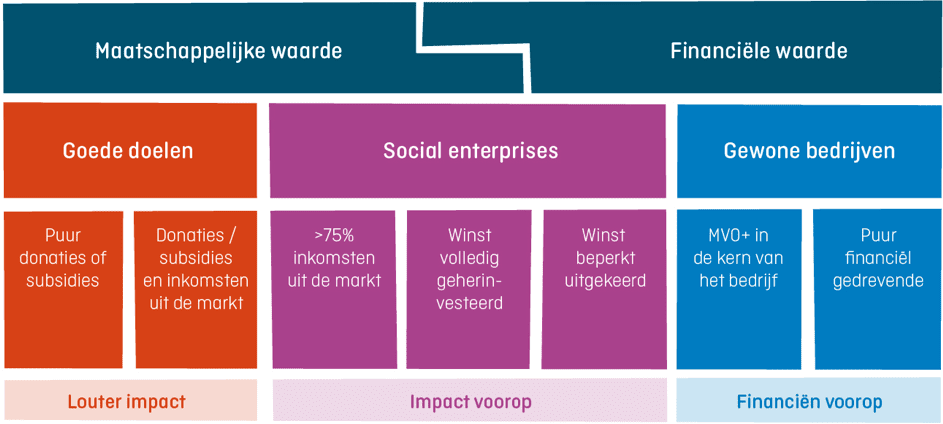
The diagram above shows how social enterprises compare to conventional businesses and charities (source: Social Enterprise NL).
Opportunities and Barriers to Social Entrepreneurship
Social entrepreneurship offers a business opportunities in various areas. However, there are still barriers to overcome. A brief explanation:
Opportunities
This is how your business can truly make a positive impact on society. Research by Social Enterprise has shown that nearly 50% of social enterprises contribute to increasing employment and labor force participation among vulnerable groups. In addition, social enterprises also make an impact in areas such as sustainable production, improving healthcare, and more.
Social entrepreneurship is also synonymous with transparency—both toward relevant stakeholders and toward the company’s own employees. Social entrepreneurship offers the opportunity to involve employees in the vision, mission, goals, and day-to-day operations. Furthermore, such enterprises are often completely open about their business operations and the pursuit of social goals, and they share their knowledge with other companies and/or the government. Transparency equals trust, and this is often evident in social enterprises.
Barriers
Although social entrepreneurship is becoming increasingly popular, there are still barriers to overcome. For example, the gap between municipalities and social enterprises. These two parties often pursue common goals (such as recycling waste, integrating people who are distanced from the labor market, reducing loneliness, etc.), yet they often still don’t know how to connect with one another. That’s a shame, because working together means making an even greater impact!
Municipalities and social enterprises
Social Enterprise recently published a study, in collaboration with PwC, on the collaboration between municipalities and social enterprises.*1 This shows that municipalities say they are on the right track, but social entrepreneurs see things differently. In their report A Vision for Sustainable Collaboration It is evident that seven recommendations deserve (extra) attention:
- Internal training to foster internal understanding
- Involve social entrepreneurs in raising awareness
- Bridge the gap between portfolio budgets
- Use the SDGs as a common language
- Implement Article 2.82 of the Public Procurement Act
- Bring small and medium-sized businesses and social enterprises closer together
- Be creative with limited financial resources
So there are still a few barriers to overcome before cooperation between (semi-)governmental entities and social enterprises can reach its full potential.
Funding
Another barrier that social entrepreneurs face is financing. It is still often difficult for such entrepreneurs to find investors. Municipalities and the government offer subsidies, but sometimes these are not sufficient. The ultimate goal of a social enterprise must be to become self-sustaining and economically sound, but until that happens, many social enterprises will depend on external funding sources. This is therefore an issue that needs to be given greater priority on the (political) agenda in order to stimulate social entrepreneurship.
Rob Jansen (director of Chain) is also aware of the opportunities and barriers mentioned above. Still, he believes that barriers should never be a reason not to engage in social entrepreneurship. “There’s always a way,” says Rob. “The drive to make an impact and do something good for people and society comes first. If you really want it, you can make it happen.”
Social Entrepreneurship at Chain Logistics
For Rob, there’s no doubt that social entrepreneurship is the future of business. “More and more companies are realizing that they can do more with their business than just make a profit—that they can give back to people and society. And that’s exactly how it should be,” says Rob. “At Chain, we’ve been engaged in social entrepreneurship since 2000. Back then, we didn’t even know the term existed. For me, it was a way to bring out the best in people and find more joy in my work. So it was a revelation when I discovered that this was actually a recognized form of entrepreneurship.”
Social entrepreneurship is fully integrated into the mission of Chain Logistics. We believe it is important to make a positive contribution to the world around us. That is why we are a ‘social enterprise’—so that we can make an impact. By conducting business in a meaningful way, we do our part to improve the quality of life for others.
As a social enterprise, you have a social responsibility—something we at Chain are also mindful of. We therefore offer people who face barriers in the job market a regular job, in which they receive training in logistics services. But meaningful entrepreneurship is more than just providing jobs. It’s about offering a future. Because everyone deserves one.
Open Hiring
Social entrepreneurship at Chain Logistics is primarily expressed through our contribution to the Open Hiring pilot van Start Foundation. Open Hiring means working without applying for a job. Education and work history are not taken into account; instead, the basic principle is: if you’re willing and able to work, you can start right away. Candidates sign up and can start right away. No questions, no process—just get to work immediately. This approach gives people who are distanced from the job market, in particular, the chance to get back to work.
For Chain, Open Hiring has already resulted in a significant number of new, motivated employees. People who otherwise wouldn’t have been able to find a job now look forward to coming to work every day. In short: a powerful example of successful social entrepreneurship.
Social Entrepreneurship Course
To learn even more about social entrepreneurship and everything that goes along with it, Rob took the Social Entrepreneurship course at the University of Amsterdam in 2015 and the Advanced Social Entrepreneurship course at Nyenrode in 2018.
As of 2020, the Social Entrepreneurship Course part of Utrecht University. This program has been specially developed for experienced and ambitious social entrepreneurs with a social mission. They are already successful social entrepreneurs, but are often seeking the right balance between ideals and profitability, stability and innovation, and their professional and personal lives. Throughout the program, experts provide theoretical, practical, and personal insights to help participants tackle these challenges and take their businesses to the next level.
“Participants in our program are social entrepreneurs with a variety of goals related to people and the planet,” says Nicole Verhoeven, MSc, program manager of the Social Entrepreneurship Program. “The term ‘social’ can sometimes be confusing, but it also encompasses sustainability, circularity, and climate goals. Both national and international projects are participating. These are successful social entrepreneurs—that is, those who have already defined a social mission and are successfully offering a product or service that contributes to it.”
The many success stories of current and former participants prove that the program truly contributes to a successful future as a social entrepreneur. “There are plenty of examples,” says Nicole. “Such as A Beautiful Story, ActiveCues (The Tovertafel), SliminICT, The Tea Shop, Scarf with a Story, Moyee Coffee, Fun Forest ”and much more."
She continues: “I think half of the program’s success is due to the quality of the groups. We therefore strictly monitor that quality when selecting our participants. Every participant must have something to contribute and something to gain. The group is often very diverse in terms of age, experience, and background, but the common thread is a passion for the organization’s social mission. We also focus primarily on the entrepreneur’s growth ambitions and qualities, as well as the feasibility and scalability of the social mission. We have to believe in the entrepreneur and the business plan.”
Rob is also enthusiastic about the program he completed. So enthusiastic, in fact, that he joined the board in 2020. “As a former participant, I know the potential and impact of the programs. I want everyone to have the opportunity to do business this way, and I think it’s important that more and more companies incorporate social entrepreneurship into their DNA.”
More information about the Social Entrepreneurship Program.
Social Entrepreneurship: The New Normal
Rob has a clear mission when it comes to social entrepreneurship. “Whenever possible, I try to make a positive contribution every day to the growth of the social enterprise movement, so that people see that this business model can go hand in hand with making a profit and running a financially sound company. Especially now, in 2021, your business can make a difference. So why not do it? Social entrepreneurship is no longer something that doesn’t concern you—it is the new normal.”
Want to learn more about social entrepreneurship?
Has this piqued your interest, and would you like to learn more about social entrepreneurship? If so, please contact Rob Jansen at rob.jansen@chain-logistics.nl. He'll be happy to tell you all about it.
*1 Source: Social Enterprise – ‘Insights into Sustainable Collaboration,’ a follow-up study on collaboration between municipalities and social enterprises. Publication date: Dec. 1, 2020.